

Anxious Dogs At our grooming salon, we have an affectionate nickname for certain four-legged clients: “the spicy ones.” You know the type — dogs who start trembling the moment they walk in, hide behind their owner’s legs, or, on the flip side, start grumbling at the first snip of the scissors. If you share your home with one of these fiery sweethearts, you’ve probably asked yourself, more than once and with a knot in your stomach: “Is it even possible to groom my dog without tears and drama?”
After years of working with hundreds of dogs every day here in Montreal, our short answer is a firm “yes.” But that “yes” comes with conditions: patience, an understanding of canine behavior, and what we call our “gentle approach.” In this article, we want to share exactly what we do every single day at Toutou Village — not textbook theory, but real experience from behind the grooming table.
Why Are Some Anxious Dogs Afraid of Grooming?
Before we talk solutions, we need to understand where the fear comes from. A dog who fidgets and panics during grooming isn’t being stubborn or mean; they’re simply telling us, in their own language, “I don’t feel safe.” Here are the most common causes we’ve seen firsthand:
**A bad past experience.** Maybe, somewhere else in the past, they were groomed in a rush and under pressure, and that memory stuck. Dogs have a remarkably strong emotional memory, and one painful experience can leave its mark for a long time.
**Unfamiliar sounds and tools.** The buzz of the clippers, the blast of warm air from the dryer, the vibration of the table — for a dog who has never been introduced to any of this, it all seems terrifying. Just like us: put a person in a loud, unfamiliar environment with no explanation, and anxiety is a perfectly normal reaction.
**Physical sensitivity.** Some dogs are sensitive to being touched in specific areas — the paws, the ears, the tail. Sometimes this sensitivity has a medical root; joint inflammation in senior dogs, for example, can make lifting a leg genuinely painful.
**Separation from their owner.** For many dogs, the hardest part isn’t the scissors or the water at all — it’s those few hours away from their person.
**Natural temperament.** Some breeds, and some individual dogs regardless of breed, are simply more cautious and sensitive by nature. This is neither a flaw nor an illness; it’s just their personality, and our job is to work with it, not against it.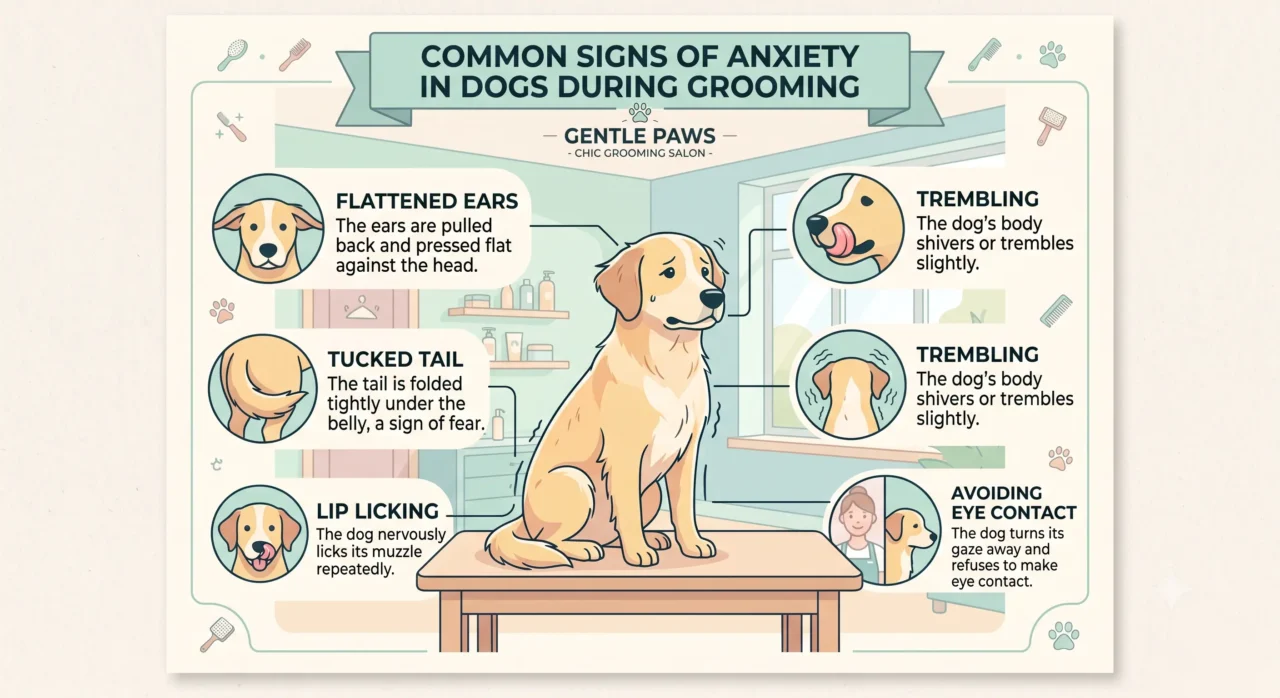
Learn to Recognize the Signs of Anxious Dogs
One of the most important lessons these years have taught us is that dogs almost always give warnings before they “explode.” The problem is that we humans usually don’t see them. If you’re a dog owner, take these signals seriously:
– Repeated licking of the lips and nose when no food is around
– Yawning over and over (in dogs, yawning is often a sign of stress, not sleepiness)
– Ears pinned back and tail tucked under the body
– Trembling, or sudden heavy shedding
– Panting without heat or exercise
– Suddenly freezing and going completely still (this one fools a lot of people — a motionless dog is not necessarily a calm dog)
At our salon, our team is trained to pace the work around these signals, not around the clock. If a dog starts licking their lips over and over in the middle of a groom, that means “give me a break” — and that’s exactly what we do.
Our Gentle Approach: Step by Step
Now for the heart of the matter. What actually happens when an anxious dog walks into our salon?
1. Getting Acquainted Before Anything Else
A fearful dog’s very first session with us is sometimes not a grooming session at all. We let them come in, sniff around, take a few treats from our hands, and go home. From the outside it might look pointless, but this “visit where nothing happens” is the foundation of trust. The dog learns: “This is not a bad place.” For more severe cases, we even recommend two or three short meet-and-greet sessions.
2. An Environment Designed for Calm Anxious Dogs
Experience has taught us that the physical space plays a huge role. At our salon:
– We book anxious dogs during quieter hours so there’s less noise and commotion.
– We use low-noise equipment and turn the dryer down for sensitive dogs — or switch to towel-drying and gentler airflow altogether.
– We cover the grooming table with a non-slip mat. You wouldn’t believe how many so-called “difficult dogs” were simply afraid of sliding on a metal surface, not of the grooming itself.
– We diffuse dog-specific calming scents in the space, which supports natural relaxation.
3. The “Little by Little, With Rewards” Technique
Our core method is built on what behaviorists call gradual desensitization with positive reinforcement — but in plain language it means: every small step earns a prize.
We first bring the clippers near the dog’s body while they’re switched off; treat. We turn them on but keep our distance; treat. A few seconds of contact; treat and a kind word. Step by step, the dog’s mind starts linking the sound of the machine to good things instead of fear. This method is slower, yes — but the results last: a dog who, by the third or fourth session, walks into the salon on their own, tail wagging.
4. Planned Breaks
A full grooming session can be exhausting for an anxious dog. So we break the work into pieces: ten minutes of grooming, a few minutes of play or a short walk, then back to work. Sometimes we even split a complete groom into two separate appointments. Yes, it takes more time — but our goal is not “finishing the job fast.” It’s “an experience the dog is willing to repeat.”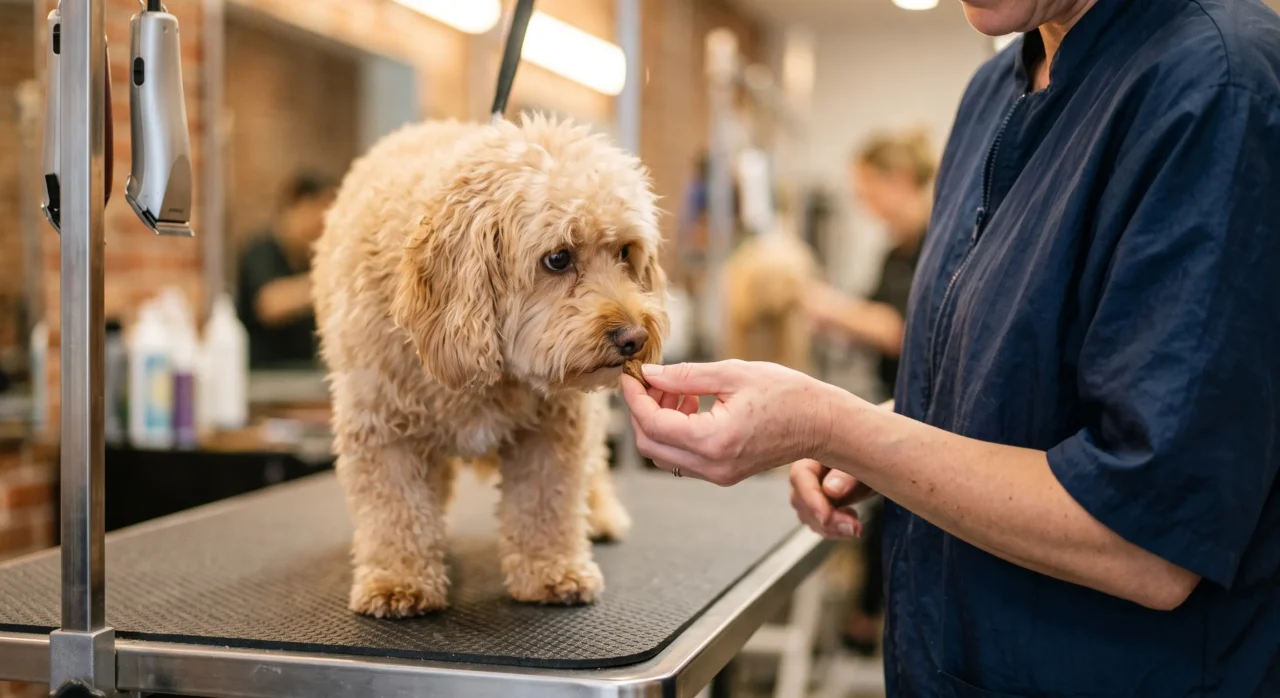
5. Never Force, Never Punish
This is our red line. A dog who is restrained by force might get groomed that day, but their fear multiplies tenfold and the next session becomes even harder. If a dog is genuinely not ready during a session, we tell the owner honestly and build an alternative plan. Your trust and your dog’s emotional well-being matter more to us than any single appointment.
What Can You Do at Home?
The gentle approach doesn’t only happen inside the salon; half the journey takes place in your home. Here’s what we tell all of our clients:
**Practice daily touch.** Every day, spend a few minutes gently touching your dog’s paws, ears, and tail, and give a treat right away. A dog who is comfortable being handled is already halfway there.
**Turn brushing into a pleasant habit.** Start with a soft brush and very short sessions — even thirty seconds is enough. What matters is that the experience ends on a good note, not that every tangle gets brushed out that same day.
**Introduce the sounds in advance.** Play a recording of a dryer or clippers at low volume at home while your dog is eating or playing. Gradually raise the volume over time.
**Stay calm yourself.** Dogs mirror our emotions. If you’re worried and fussing during drop-off, your dog will conclude, “Something bad must be coming.” A short goodbye, a normal tone of voice, and leaving without lingering is the best help you can give.
**Burn off energy before the appointment.** A good walk before the visit works wonders. A dog with no excess energy has a much higher tolerance threshold.
Tools and Products That Actually Help
Since we sell pet supplies alongside our grooming services, we’re constantly asked: “What should I buy to help my anxious dog?” The honest answer is that no product works magic on its own — but combined with training, these make a real difference:
– **Soft brushes with a comfortable grip** for at-home practice; harsh brushes create bad experiences.
– **A non-slip mat** for baths or home grooming; feeling stable underfoot brings calm.
– **Small, low-calorie training treats** you can give plenty of in one session without worrying about weight gain.
– **Lick toys** you can smear with spreadable treats; licking naturally calms dogs and distracts them from the groomer’s work.
– **Dog-specific calming scents** in diffuser or collar form, which have a noticeable effect on some dogs.
If you’re not sure which option suits your dog, just ask us at your next visit. Advice is free, and we would much rather sell you something that genuinely works for you.
When Should the Vet Get Involved?
Professional honesty requires us to say this too: some anxiety goes beyond what a groomer and home training can handle. If your dog:
– panics severely in many different situations (not just grooming),
– shows a pain response when a specific part of the body is touched,
– or has made no progress despite several months of gentle training,
please consult your veterinarian. Sometimes the root of the problem is hidden pain, and sometimes the vet can suggest a temporary medical solution for grooming sessions. We’re always happy to coordinate with your vet; teamwork for your dog’s welfare is part of what “professional” means to us.
One Last Word: The Spicy Ones Are Our Favorites
It might sound strange, but “the spicy ones” are our most beloved clients. Because there is no greater joy than watching a dog who arrived trembling with fear on day one walk in a few months later with a wagging tail, heading straight for the treat jar. That transformation doesn’t happen overnight; it’s the result of patience, repetition, and teamwork between you, us, and sometimes your vet.
If you live in Montreal and your dog is one of these lovable spicy characters, we’d love to hear their story. Book a short meet-and-greet session for them — no scissors, no pressure, just a few treats and a whole lot of patience. We promise to treat them the way we’d want our own dearest family member treated — because that’s exactly what they are.
It depends on the severity of the anxiety and your own skill level. Simple exercises like brushing and daily handling should absolutely happen at home, because they’re the foundation of trust-building. But a full groom — haircut, nail trimming, ear cleaning — is best done under the care of a groomer experienced with anxious dogs, because one wrong move (cutting a nail too short, for example) can undo all the trust you’ve worked to build. The ideal setup is a combination of both: practice at home, professional grooming at the salon.
The honest answer: it’s different for every dog. Our experience shows that most dogs make noticeable progress after two to four gentle sessions, but dogs with a history of bad experiences may need several months and separate meet-and-greet sessions. One important thing to know: progress is never a straight line. You might have one excellent session followed by a small setback the next time. That’s completely normal and shouldn’t discourage you.
Never give your dog any medication or calming supplement without a veterinarian’s prescription — even products marketed as “herbal” or “natural,” because proper dosing and possible interactions need to be assessed by a vet. For severe cases, a veterinarian may prescribe an appropriate medication for grooming sessions, and this is completely common and accepted practice. But for most dogs, the combination of gradual training, positive reinforcement, and a calm environment gets results without any medication at all.
Good article about anxious dog can u write about cat too?
sure will write about anxious cats